
Written by Allen Lee
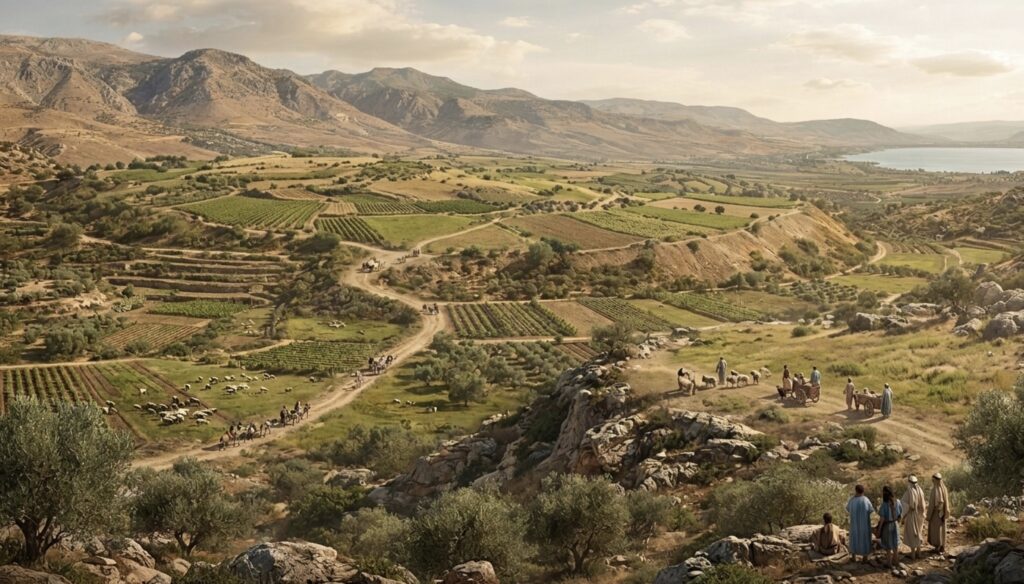
Abraham lived in Mesopotamia. In obedience to God’s instruction, he left his country and travelled to Canaan (Acts 7:2–4). While in Canaan, God promised to give the land to Abraham’s descendants:
“To your descendants I will give this land” (Genesis 12:7).
God later renewed this promise:
“Lift your eyes now and look from the place where you are—northward, southward, eastward, and westward; for all the land which you see I give to you and your descendants forever” (Genesis 13:14–15).
The promise was repeated in Genesis 17:8 and was later reaffirmed to Isaac (Genesis 26:3–4) and Jacob (Genesis 35:12).
Following the Exodus, the Israelites entered the Promised Land under the leadership of Joshua, around 1405 BC. In later centuries, they were conquered by foreign powers: first by the Assyrians in 722 BC, and later by the Babylonians in a series of invasions beginning in 605 BC. By God’s grace, many Jews were eventually permitted to return from captivity.
The land later came under Roman rule. Following Jewish revolts against Rome in AD 66–70 and AD 132–135, many Jews were expelled from Jerusalem and scattered throughout various regions.
Over the centuries, Arab people became established in the land. In the late nineteenth century, the Zionist movement emerged, seeking to establish a national homeland for the Jewish people. This movement received support from Britain, which was given the mandate over Palestine by the League of Nations after the First World War.
Britain’s principal obligation under the mandate was to implement the Balfour Declaration. This declaration expressed support for the establishment of a national home for the Jewish people and committed the British Government to use its best efforts to facilitate that objective.
After the Second World War, the issue of resettling Jewish refugees became increasingly urgent. However, allowing large numbers of Jews to immigrate to Palestine intensified the already strained relationship between Jews and Arabs. The United Nations Special Committee on Palestine recommended that Palestine be divided into an Arab state and a Jewish state.
In May 1948, the modern nation of Israel was established. When the British withdrew, war broke out between Israel and the surrounding Arab nations.
Many Jews today view the land they occupy as having been given to them by divine promise. This view is also held by some denominations, particularly those who hold to the erroneous doctrine of premillennialism—the belief that Christ will one day return to earth, establish His kingdom, and reign from Jerusalem for one thousand years.
At the same time, some Arab groups do not recognise Israel as a legitimate nation and seek to remove the Jews from the land. This conflict has contributed to prolonged tension, suffering, violence, and loss of life on both sides.
What Is the Biblical Perspective?
Do the Jews have a divine right to possess the land of Palestine?
1. “Forever” and “everlasting” do not necessarily mean uninterrupted possession without end
Words such as “forever” in Genesis 13:14–15 and “everlasting” in Genesis 17:8 do not necessarily mean that Israel would occupy the land continuously and without interruption throughout all history.
For example, the Passover feast was described as an “everlasting ordinance” and was to be observed “forever” (Exodus 12:14, 24). Yet it was a shadow pointing forward to Christ, our true Passover (1 Corinthians 5:7; Colossians 2:16–17).
Similarly, the Levitical priesthood was described as an “everlasting priesthood” (Numbers 25:13). However, Hebrews 7:12 teaches that the priesthood was changed. Circumcision was also described as an “everlasting covenant” (Genesis 17:10, 13), yet the New Testament teaches that, in Christ, “neither circumcision nor uncircumcision avails anything” (Galatians 5:6).
Therefore, the terms “forever” and “everlasting” do not always mean an unending duration in the same form. They may refer to something that continues according to God’s purpose until it is fulfilled, changed, or brought to its intended completion.
2. Israel’s continued occupation of the land was conditional upon obedience to God
Scripture teaches that Israel’s continued possession of the Promised Land was connected to faithful obedience to God.
In his farewell address, Joshua reminded the Israelites that not one of God’s good promises had failed (Joshua 23:14). This included God’s promise to bring them into the land of Canaan (Judges 2:1).
However, Joshua also warned them that if they broke God’s covenant and served other gods, God’s anger would burn against them:
“You shall perish quickly from the good land which He has given you” (Joshua 23:16).
Thus, while God faithfully fulfilled His promise to give Israel the land, their continued enjoyment of the land was dependent upon their covenant faithfulness.
Moses also warned that disobedience would lead to removal from the land
Moses, who reminded God of His promises to Abraham, Isaac, and Jacob (Exodus 32:13), also understood the conditional nature of Israel’s continued possession of the land.
He warned the Israelites that if they failed to obey God’s law, God would bring severe judgement upon them and their descendants (Deuteronomy 28:58–61). He further declared:
“Just as the LORD rejoiced over you to do you good and multiply you, so the LORD will rejoice over you to destroy you and bring you to nothing; and you shall be plucked from off the land which you go to possess” (Deuteronomy 28:63).
See also 1 Kings 9:6–7.
The history of Israel records many instances of disobedience and rebellion against God. The rejection of God’s Son was the ultimate expression of this rebellion. Jesus foretold the destruction of the temple (Matthew 24:1–2), the devastation of Jerusalem (Matthew 22:7; Luke 21:20), and the captivity and scattering of its people (Luke 21:22–24).
3. The ultimate fulfilment points beyond an earthly land
The New Testament teaches that the true children of Abraham are not merely those who are physically descended from him, but those who belong to God through faith (Romans 9:8; Galatians 3:7, 29).
In this sense, the Promised Land points beyond Canaan to the greater spiritual reality of God’s eternal rest and heavenly inheritance. Hebrews 4:8–11 shows that the ultimate promise of rest is not limited to the land of Canaan but points to the rest God provides for His people.
For Christians today, the central hope is not the possession of an earthly territory. Our true homeland is the heavenly city prepared by God:
“They desire a better, that is, a heavenly country” (Hebrews 11:13–16).
Therefore, while Christians should pray for peace, justice, and the protection of all people affected by the Middle East conflict, our hope must remain centred on Christ and His eternal kingdom—not on earthly borders or political claims.